
A common language of trust: what NRC and Norwegian Church Aid had to say about CHS verification
At a meeting hosted by Norad and convened with HQAI and CHS Alliance, the Norwegian Refugee Council and Norwegian Church Aid spoke openly about what CHS certification has meant for them, from donor relationships to closing the loop with communities.
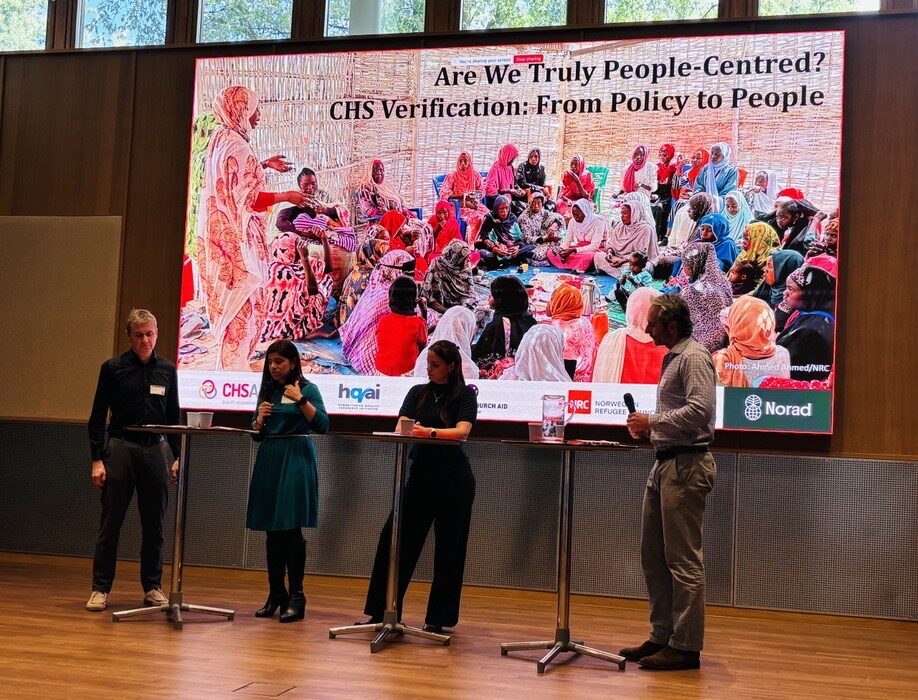
From left: Martin Andreas Suvatne and Maria Paula Arenas Grundetjern (NRC), Daniela Visekruna and Andrés Miguel España (NCA).
At a recent meeting hosted by Norad, convened with HQAI and CHS Alliance, the Norwegian Refugee Council (NRC) and Norwegian Church Aid (NCA), two organisations with long experience of CHS verification, spoke openly about what certification has meant for them.
At a recent meeting hosted by Norad, convened with HQAI and CHS Alliance, the Norwegian Refugee Council (NRC) and Norwegian Church Aid (NCA)
For NCA, the value starts with independence. “It’s about not self-assessing and tapping ourselves on the shoulder,” said Daniela Visekruna, who coordinated NCA’s latest certification. External auditors test whether “the intentions that we have really come out in practice” in the communities NCA serves. The process is rigorous: hundreds of pages of evidence and on-site visits in Ethiopia and Zambia. But, she said, “it’s very necessary”, and it makes accountability practical rather than conceptual.
For NRC, Maria Paula Arenas Grundetjern said the certification process showed “where the gap was”, bringing risk and compliance, safeguarding, programmes and community engagement teams together. When NRC restructured after the USAID cuts, the CHS audit findings helped leadership decide which functions had to stay.
The payoff shows up in donor relationships. Martin Andreas Suvatne, NRC’s Director of Institutional Partnerships, said donors fundamentally want to know whether they can trust an organisation. A trusted quality label means they don’t have to repeat every compliance check themselves. Beyond saving time, “we suddenly speak a common language… nothing is lost in translation.”
His examples were concrete. In NRC’s accreditation to the Green Climate Fund, CHS documentation did “60 to 80% of the job”. A recent Sida partnership application referred to CHS elements in 12 separate sections. With FCDO, passporting is already in place.
NCA pointed to the ACT Alliance, with 164 members in 120 countries, which is building a due diligence passport that draws on the CHS self-assessment and the Charter for Change tool. “Passporting is happening,” the panel said.
There is further to go. An NCA colleague described a peer NGO’s due diligence request that took one staff member a week, with 18 people consulted. If NGOs relied on the CHS for “80% of the internal due diligence process,” he argued, the savings would be substantial.
Above all, both organisations kept returning to the people they serve. In Ethiopia, one of the NRC country offices visited by auditors, teams still use materials from the process to go back to communities and close the feedback loop. In Angola, NCA colleagues said community consultations mean projects are now seen as the communities’ own.
So is it worth it? Daniela Visekruna put it simply: if the aim is to keep people at the centre and have a good impact in their communities, “having that certified is worth it in itself.”
Want to explore how CHS verification could reduce your due diligence burden? Contact verification@chsalliance.org or join our Donor Recognition Working Group on 27 October.