
A New Strategy to Scale Collective Accountability
As we navigate the turbulence of recent years—marked by the shockwaves of swinging cuts to staff and resources— CHS Alliance has launched its new “Strategy 2026 – 20230: Collective Solutions for More Accountable Aid” to help us navigate the storm. It puts the emphasis on how we move forward to create collective solutions with and for people affected by crisis, while staying grounded in the core commitments and principles that have guided humanitarian work for so long.
Accountability has never been more critical. The Core Humanitarian Standard (CHS) continues to underpin this strategy, but we recognize that it is our diverse global network of nearly 300 members, alongside the wider humanitarian sector, that will collectively drive the solutions so urgently needed.
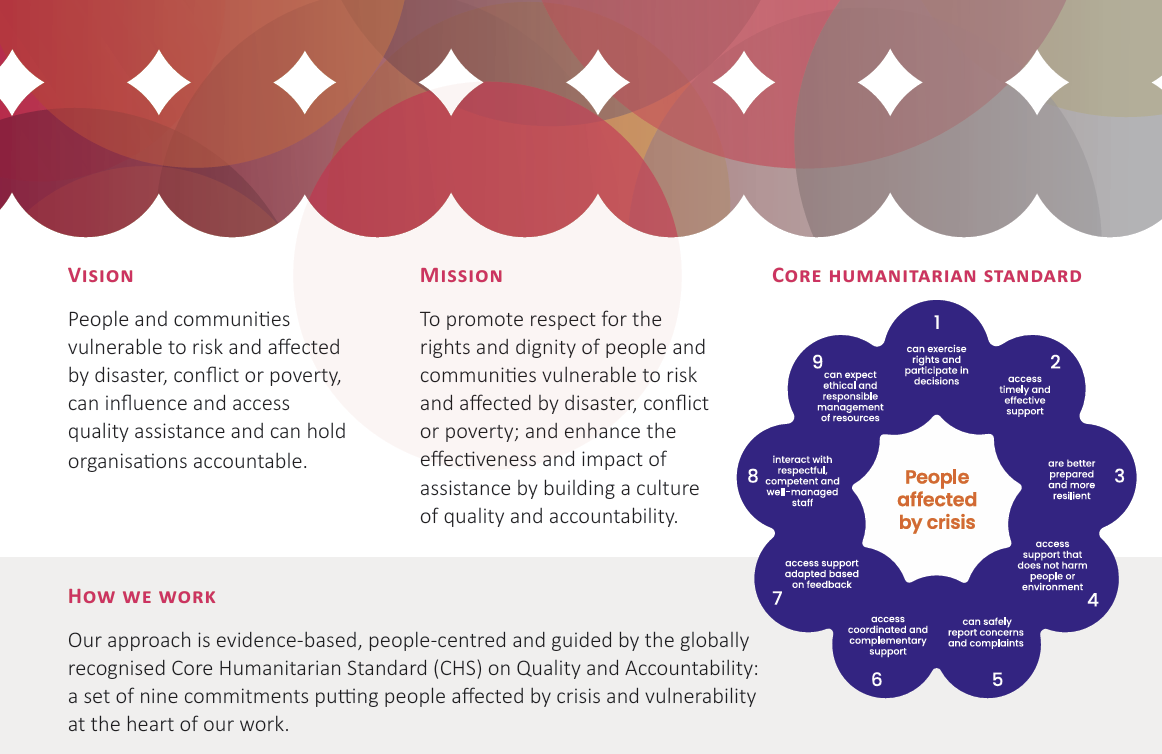
As we enter this new phase, our vision and mission remain unchanged. However, our strategy places stronger emphasis on two key objectives to ensure aid is more accountable, effective, and safe:
Objective 1: Enhance Organisational Capacity
“Shrinking funds, tightening civic space, and growing crises remind us that collaboration is not optional but essential. We must move beyond competition and ensure that people affected by crisis are at the centre of decisions. This strategy operationalises this principle through formal platforms for shared learning, pooled services and collective assessments, aiming to move accountability from an individual organisational burden to a system-level responsibility.”
Palwashay Arbab, CHS Board Member and Head of Communications at Community World Service Asia
We are committed to helping organisations improve the quality and safety of their assistance through two key pillars:
- Continuous Improvement: We are moving beyond checkbox accountability. Members will be supported to verify against the updated CHS and advance their improvement plans through tailored guidance and Communities of Practice.
- Courageous Collaboration: In the coming five years, we want to see deep, country-level collaboration and action. We must treat knowledge and tools as shared assets, using our diverse network to support innovative partnerships that tackle the most persistent challenges in the sector.
Objective 2: Harness the Influence of a Global Movement
“Building trust with communities and donors requires strong quality and accountability systems, including clear policies, effective processes, and consistent practice. Due Diligence Passporting offers a practical solution by reducing duplication and streamlining partner assessments across funding partners.”
Rizwan Iqbal, Global Quality & Accountability Coordinator, ACT Alliance
To create a more locally-led aid system, we have to leverage the individual organisational efforts to create system-wide solutions:
- Collective Action: The time for duplication is over. We are advancing CHS Due Diligence Passporting to reduce overlapping assessments and remove barriers to locally-led response. Similarly, we are scaling harmonised efforts to prevent SEAH through the Misconduct Disclosure Scheme (MDS) and the Harmonised Reporting Scheme (HRS), asking not if organisations should join, but why they haven’t already.
- Informed Influence: We will no longer see data as internal performance metrics. By using evidence from collective country assessments and CHS verification data, we will amplify the voices of people affected by crisis to advocate for bold sector reforms with donors and governments.
“The provision of collective humanitarian public goods (including data, funding, supply chains and coordination) must be distributed, not centralised. This focus on evidence-informed advocacy is intended to strengthen the sector’s collective voice on localisation, safeguarding and accountability, particularly in the context of the ongoing humanitarian “reset.”
Gareth Price-Jones, Steering Committee for Humanitarian Response, International Red Cross and Red Crescent Societies
Collective Path Forward
As ever, I continue to be inspired and humbled by the extraordinary work of colleagues in desperately challenging circumstances. This strategy is not about critiquing or undoing the great work that has been done. Instead, this strategy builds on our progress through harnessing the richness of our network. Take a look at the strategy and challenge yourselves on where can we collaborate? Where is a collective voice, solution, or tool stronger than an individual one? What do we need to try, and what can we leave behind?