
CHS Alliance at HNPW 2026
Four sessions. One question that wouldn’t go away.
What does it actually take to make aid more accountable? Not in principle, but in practice, right now, when budgets are shrinking, trust is eroding, and the sector is being asked to reset?
That was the thread running through CHS Alliance’s participation in the Humanitarian Networks and Partnerships Week 2026. The HNPW ran online from 2 to 6 March, followed by three in-person days at the CICG in Geneva from 10 to 12 March. Across four sessions, CHS Alliance brought together practitioners, researchers, community representatives, and sector leaders to move past the familiar conversations and get honest about what is working, what is failing, and what needs to change.
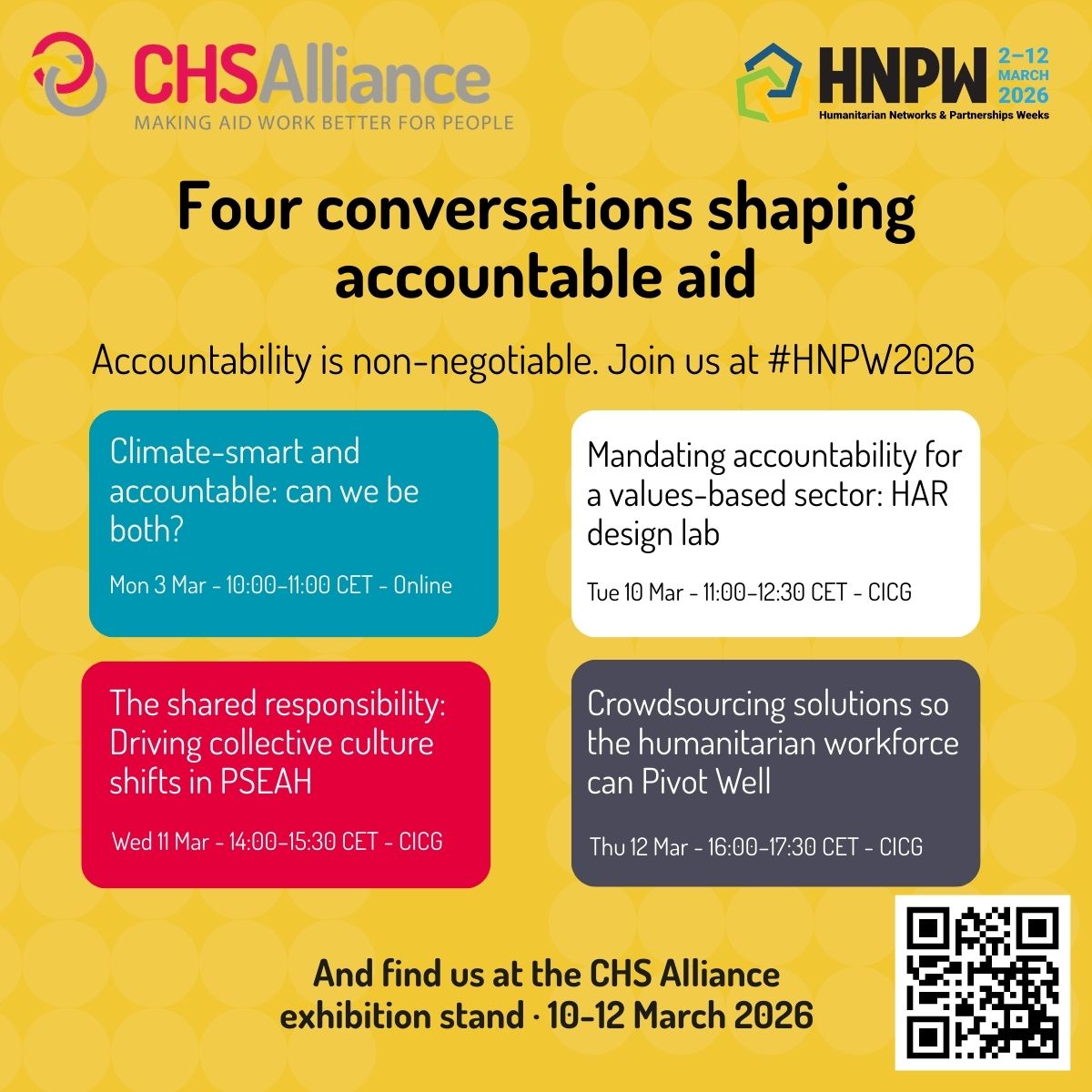
Event details for CHS Alliance at HNPW 2026
The sessions
We opened on 3 March with a question about climate: can an organisation be both climate-smart and accountable? Co-hosted with the Secretariat for the Climate and Environment Charter for Humanitarian Organizations, the session made the case that these are not competing agendas. Through practical examples from the field, including how one organisation’s CHS verification process surfaced uncomfortable environmental gaps and drove real institutional change, participants heard what it looks like when accountability and climate action reinforce each other rather than compete.
On 10 March, we stopped being polite. The session contributing to the 2026 Humanitarian Accountability Report opened with a line that stayed in the room: dignity is not a budget line. Voices from South Sudan, DRC, and across the international system described what is happening when funding tightens: the time to listen is the first thing cut. The lead researcher for the report described the current moment as a stress test of 20 years of commitments. Panellists challenged the sector to stop waving institutional flags, merge duplicated initiatives, and get honest about the political economy of accountability. The room agreed on one thing: we cannot come back in five years and have the same conversation.
On 11 March, the PSEAH session on shared responsibility did something different. Rather than discussing sexual exploitation, abuse and harassment from a distance, participants stepped inside a simulation built from real, recurring trends observed across the sector: the same perpetrator, three different contexts, three different years. When asked whether to act, wait, or do nothing, 18 of 24 participants chose to act immediately. The data tells us why that matters: 26% of perpetrators currently face no consequences. These numbers are not inevitable. Preventing and addressing harm is a shared responsibility.
On 12 March, we asked what happens when the workforce itself is in crisis. The Pivoting Well session previewed findings from the forthcoming Pivoting Well Report, exploring five adaptations emerging in pockets of the humanitarian workforce (Preserve, Pool, Align, Support, and Act) and what blocks and enables each. Participants named it plainly: fear, shame, multilayered grief, and the belief that there is no individual solution to a collective wound. Stay tuned for the release of the Pivoting Well report for inspiring examples and ideas for courageous collaboration.
The booth
Between sessions, our exhibition stand posed one question to everyone who passed: what makes aid more accountable? Responses came back in Arabic, Chinese, French, Georgian, Korean, Kyrgyz, Portuguese, Spanish, Urdu, English, and more. People called for flexible funding, local ownership, transparent data, decolonisation, and support for the workforce. One message, written in Korean and translated by the person who wrote it, captured the spirit of all four days: “Listen to local communities and youth. Not just to listen but to act together.”
The board filled up. The gap is not closed… yet.